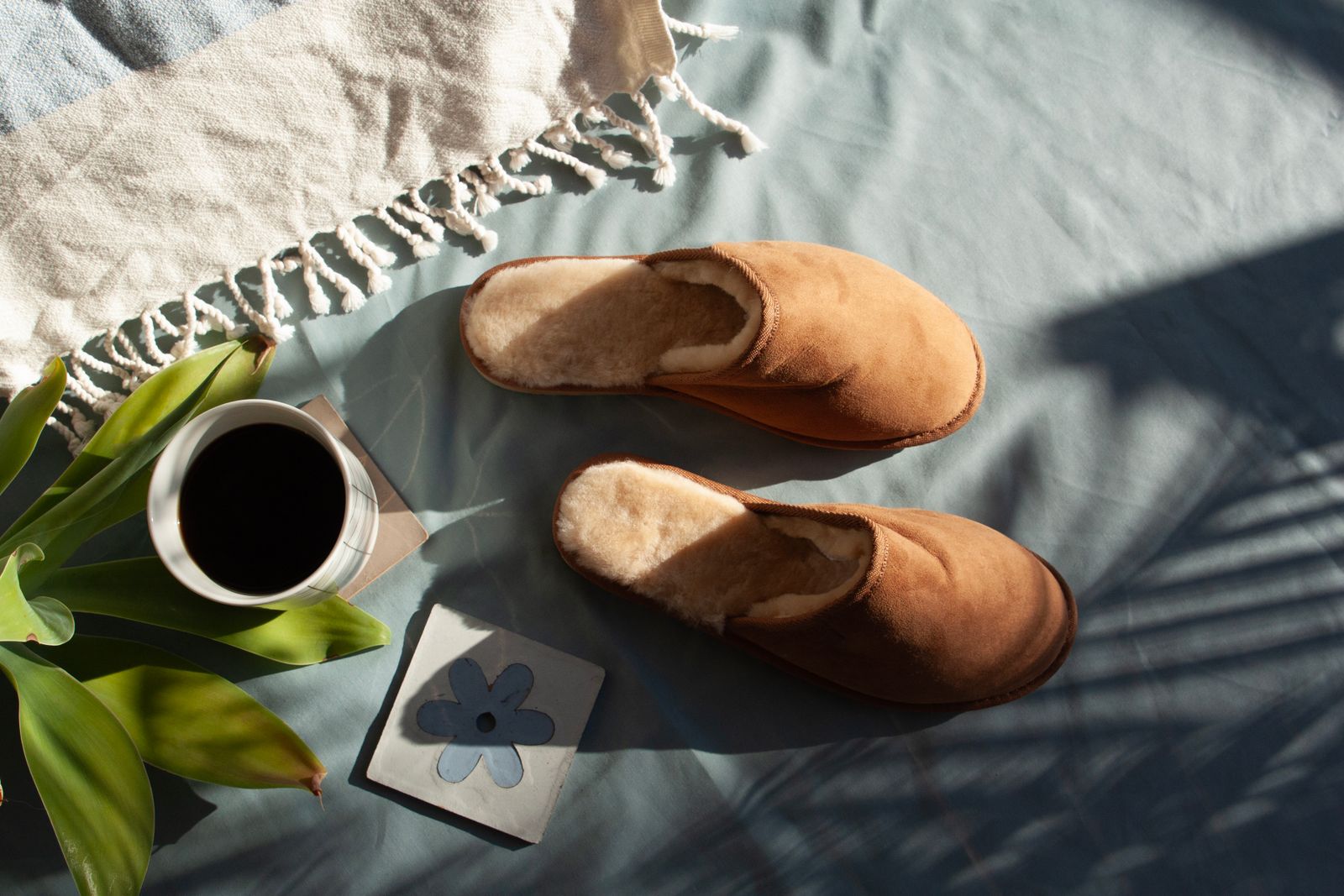
How Should House Slippers Fit? Plush Slip-On Sizing and Sock Choices
House slippers should fit closer than a shoe you walk outdoors in but with more room than a dress shoe: your foot sits fully inside, your heel stays put when you lift it, and nothing presses at the sides or across the top. With plush slip-on styles, the plush itself takes up space, so a pair that feels snug on the first wear will usually settle into a softer, roomier fit. This guide explains how to judge that, and what to do when you land between sizes.
What a correct slipper fit actually feels like
A well-fitted plush slipper is easy to describe in feel rather than measurements. When you stand up in the pair:
- Your longest toe has a small amount of clearance at the front, not a pressed-flat feeling and not a gap you can wiggle the whole foot into.
- The widest part of your foot sits in the widest part of the slipper, without the plush being stretched tight across the sides.
- Your heel stays in contact as you take a normal step, rather than lifting away and slapping back down.
- The top of the foot feels covered, not compressed. No band of pressure across the instep.
- Nothing has to be gripped or curled with your toes to keep the slipper on.
Why plush fabric changes how you should size
Soft plush behaves differently from a firm shoe upper. Three effects matter.
It compresses. A plush lining is thickest when new. Normal wear presses it down, and the interior of the slipper effectively gains a little space over the first weeks. A pair that felt cozy-snug at first often becomes cozy-relaxed.
It's warm, so it changes your sock choice. Plush and a thick wool sock together can fill a slipper in a way that neither does alone. Decide before you size which combination you actually plan to wear most.
It gives sideways rather than lengthwise. Soft uppers accommodate a wider foot reasonably well. They do not add length. If your issue is length, sizing up is the fix; if the issue is width, a soft plush upper is already working in your favor.
The Wendy House Slippers are built around soft plush fabric and a lightweight construction with a comfortable slip-on design, which means the fit is judged mostly by the two things above: how much room the plush leaves you, and how the pair feels once that plush has settled.
Between sizes? Here's how to decide
| Your situation | Better choice | Why | |---|---|---| | You wear thick socks indoors most days | The larger size | Plush plus a heavy sock needs real room | | You wear slippers barefoot | The smaller size | No sock volume to account for; too much room causes shuffling | | Your feet are wide | The larger size | Length adds width in most builds | | You'll wear them for long stretches at a desk | The larger size | Long wear is more forgiving of room, less forgiving of pressure | | You'll be up and down stairs constantly | The smaller size | A closer fit keeps the heel from lifting | | You feel a little swollen by evening | The larger size | Comfort should hold at the end of the day, not just the start |
When two rows conflict, weight the one that matches how you spend most of your indoor hours. A slipper that fits your typical evening beats one that fits a hypothetical one.
How to check the fit in five minutes
If a pair passes all five, you have the right size. If it fails only the heel test, you may be a size too large. If it fails the toe clearance check, you're a size too small, and no break-in period will fix that.
Common fit mistakes with indoor footwear
Photo by cottonbro studio on Pexels
Buying by outdoor shoe size alone. Your sneaker size is a good starting point, not an answer. Indoor footwear is worn differently, often over different socks, and often for longer continuous stretches.
Treating "cozy" as "tight." Cozy comes from soft material against the foot, not from compression. A slipper squeezing your foot feels warm for ten minutes and unpleasant for the next two hours.
Sizing way up for comfort. Excess room makes you shuffle, and shuffling is both tiring and unsteady on smooth floors. Extra length is not extra comfort.
Ignoring how the pair feels on hard flooring. Carpet flatters everything. A slipper's real fit shows up on tile and hardwood, where the sole and the fit have to do more work. The piece on choosing indoor footwear for lounging at home goes deeper on this.
Judging the fit in the first minute. Give a new pair a couple of evenings before deciding, unless something is clearly wrong. Plush needs a little wear to reveal its settled shape.
Does the fit change over time?
Yes, and mostly in a predictable direction. The plush interior compresses gradually, so the pair feels a touch roomier after a few weeks of regular wear. That's normal and generally welcome, because it happens slowly enough that the fit stays consistent day to day.
Washing is the other variable. Any soft fabric can shift slightly with laundering and drying, so follow the care instructions on the pair you own rather than a general rule. Gentle handling and low heat protect both the plush and the shape. The guide to maintaining your slippers covers the routine that keeps a good fit good.
If your pair starts to feel loose in a way that makes you shuffle, a slightly thicker sock is the simplest correction. It's a small adjustment that restores the closer feel without replacing anything.
Frequently asked questions
Should house slippers fit tighter or looser than sneakers? Similar in length, more relaxed in feel. You want the same toe clearance you'd expect in a comfortable sneaker, without the snug lockdown a laced shoe provides.
How much toe room should there be? A small amount of clearance at the front, enough that your toes never press against the end when you take a step. If you can slide your foot forward and still have obvious empty space, that's more room than you need.
Do slippers stretch out? Soft plush uppers relax and the lining compresses, so the interior feels a little more open over time. That is not the same as stretching in length. Don't buy a too-short pair expecting it to grow.
What if one foot is larger than the other? Size to the larger foot and use a slightly thicker sock on the smaller one if you want a closer feel. Forcing the larger foot into a smaller pair is the one version of this that never works.
Where to go from here
Take your everyday shoe size, decide whether you'll wear socks or go barefoot, and pick accordingly: barefoot leans smaller, thick socks lean larger. Then test the pair in the evening, on the floors you actually walk, over a normal ten-minute circuit of your home. That single test tells you more than any measurement, and it takes less time than reading about it. For a broader look at what separates a comfortable pair from a merely soft one, see the guide to choosing women's slippers.
Cover photo by Karen Laårk Boshoff on Pexels.