I stopped judging slippers by softness after one wet-step test
 Jordan HaleStaff Writer
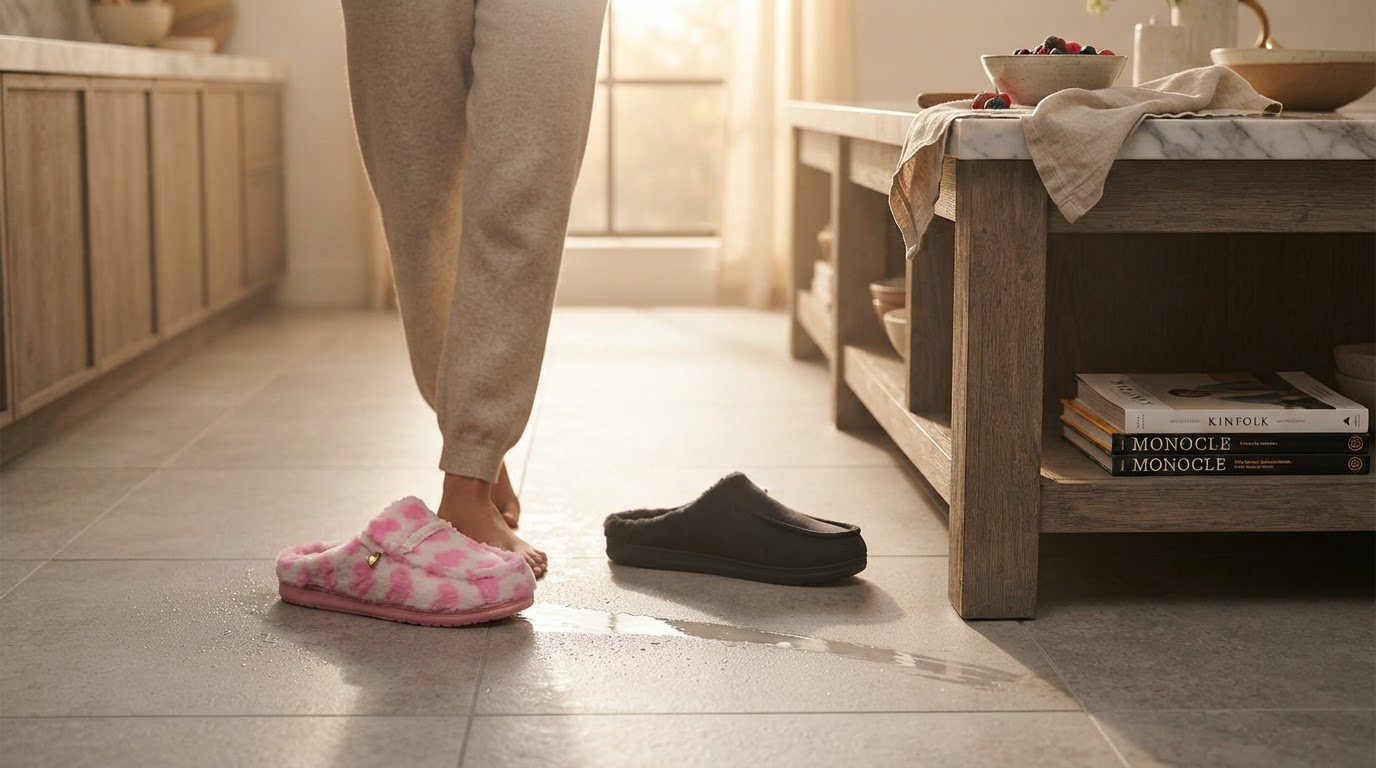
I changed how I evaluate house slippers after a 4-foot walk across misted kitchen tile: the plushest pair in my basket slid 11 inches on the first push-off, while a firmer, less “cloud-like” pair moved less than 2 inches.
That was not a laboratory certification. It was a practical, slightly annoying test I started doing after seeing the same pattern in real homes: the slippers people love on the sofa are not always the slippers they trust at 6:40 a.m. when the kettle spills, the dog tracks in rain, or the bathroom floor is still damp from a shower.
At wendyhouseslippers.com, we sell Wendy House Slippers, so I care about comfort. But I’ve become more interested in a less glamorous question: what happens in the first three steps after comfort stops being the only variable?
Below is the decision framework I use now. It is part field observation, part standards-aware common sense, and part “I have walked around enough kitchens in slippers to stop being impressed by fluff alone.”
The slipper mistake I see most often
Most buyers start with hand-feel. They squeeze the lining, bend the upper, and look for softness. I understand why. A house slipper is intimate in a way outdoor shoes usually are not. You wear it when you are tired, half-awake, cold, or trying to make the house feel less like a list of chores.
But hand-feel tells you almost nothing about three things that matter once you stand up:
The National Institute on Aging points out that many falls happen at home and recommends removing trip hazards, improving lighting, and using supportive shoes or non-slip footwear as part of fall prevention. That matters because slippers are often worn in the exact zones where falls happen: bedrooms, bathrooms, kitchens, stairs, laundry rooms, and entryways.
I am not saying a slipper can make a home “fall-proof.” It cannot. But a slipper can either cooperate with the floor or make every pivot a little less predictable.
My non-lab wet-step observation
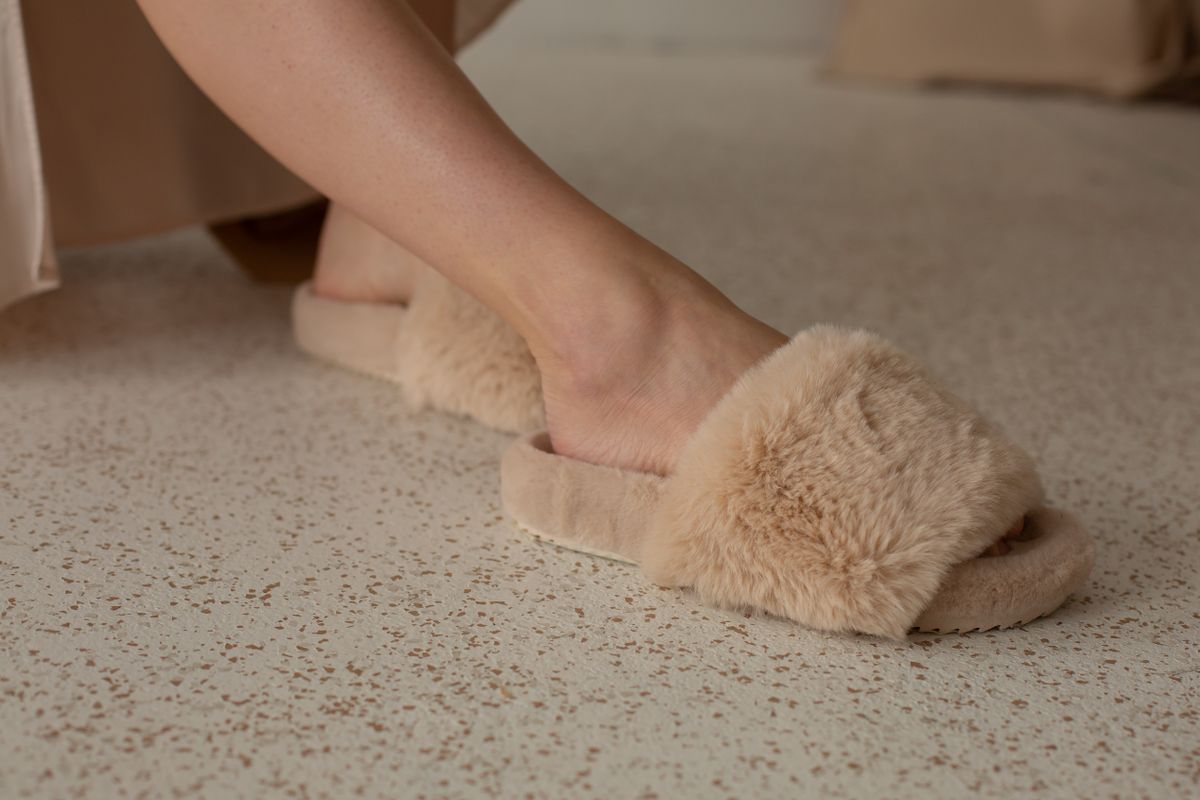
Photo by KATRIN BOLOVTSOVA on Pexels
I used six common indoor footwear styles I had on hand or had been evaluating: a backless plush mule, a memory-foam scuff, a knit bootie, a rubber-soled indoor-outdoor slipper, a flexible moc-style slipper, and a Wendy House Slipper sample with a textured sole and enclosed heel shape.
The setup was simple:
- Smooth ceramic kitchen tile.
- One light spray of water over a 2-by-3-foot area.
- Same wearer, same cotton socks.
- Ten slow walking passes per pair.
- One basic observation: did the push-off slip, twist, or feel controlled?
| Slipper style tested | Heel coverage | Sole pattern depth observed | Push-off movement on misted tile | Turn-in-place feel after 10 passes | My note | |---|---:|---:|---:|---|---| | Backless plush mule | None | Under 1 mm | 9–11 in. slide | Wobbly | Soft on the sofa, poor when hurried | | Memory-foam scuff | Low lip | About 1 mm | 5–7 in. slide | Heel drift | Comfortable, but foam compressed fast | | Knit bootie with fabric dots | Full | Dots under 1 mm | 4–6 in. slide | Warm, slightly twisty | Better warmth than traction | | Moc-style slipper | Partial | 1–2 mm | 3–4 in. slide | Stable if snug | Fit mattered more than lining | | Indoor-outdoor rubber sole | Full | 2–3 mm | 1–2 in. slide | Most planted | Heavier, less cozy | | Wendy House Slipper sample | Full/secure | 2 mm textured sole | 1.5–2.5 in. slide | Controlled | Good balance of cozy and grippy |
The number that changed my mind was not the shortest slide. It was the difference between the backless plush mule and anything with real heel retention. The slipper without a back did not simply slip forward; it changed my stride. I shortened my step and curled my toes to hold it on.
That toe-clenching habit is easy to ignore, but it is one reason “soft” can secretly mean “work.”
Counter to what you’ll read elsewhere: the squishiest slipper is usually not the most comfortable
My take: if a slipper feels unbelievably soft in the first 30 seconds, I get suspicious.
That sounds backwards for a slipper shop, so let me explain. Extremely soft foam can feel luxurious during a try-on but collapse under body weight. Once compressed, your foot may sit lower in the slipper, your heel may ride differently, and the upper may loosen. The result is a slipper that still feels plush to your hand but feels sloppy when you walk.
A better comfort signal is controlled give: the insole compresses, but the base does not flatten into a pancake. The upper hugs without squeezing. The sole bends at the forefoot but does not twist like a towel.
This is consistent with what footwear researchers often emphasize for older adults and people at risk of falls: fit, heel support, sole properties, and stability matter. A PubMed-indexed review by Menant and colleagues on footwear characteristics and balance notes that features such as high heels, soft midsoles, and poor fixation can impair balance in older people. Slippers are not high heels, obviously, but “poor fixation” is exactly what I feel when a backless scuff makes me grip with my toes.
What standards taught me, even though slippers are not lab gear
House slippers are not industrial safety shoes, and I do not want to pretend they are. Still, standards give us useful language.
ASTM F2913 is a standard test method for measuring footwear slip resistance using a whole-shoe tester. ISO 13287 is another footwear slip-resistance test often referenced in occupational footwear contexts. These standards are more rigorous than anything a shopper can reproduce at home, but they highlight a key point: slip resistance is not a vibe. It depends on outsole material, tread geometry, floor surface, contaminant, pressure, and movement.
That last word—movement—is the one shoppers forget. A slipper can feel fine when you stand still and still misbehave when you turn toward the fridge.
When I evaluate Wendy House Slippers, I look for the everyday equivalent of those lab ideas:
- Is there tread, or is the bottom mostly smooth?
- Does the sole material feel rubbery rather than hard and plasticky?
- Does the heel stay with the foot during a turn?
- Does the slipper bend where the foot bends?
- Does the insole rebound after being pressed?
Warmth is not just lining thickness
I used to assume warmth meant the thickest lining. Now I look at three layers: the floor barrier, the foot chamber, and moisture behavior.
A cold tile floor pulls heat away quickly. A slipper with a slightly more substantial sole can feel warmer than a fluffy sock-like bootie because it creates a better barrier between your foot and the floor. That is why thin fabric booties can feel cozy on carpet and disappointing on tile.
The second layer is the foot chamber. If a slipper is too tight, it compresses the lining and reduces the warm air around your foot. If it is too loose, warm air escapes with every step. The sweet spot is boring: secure, not tight.
The third layer is moisture. Feet sweat even in winter. The NIH’s MedlinePlus notes that sweaty feet and occlusive footwear can contribute to odor and skin irritation. In slipper terms, washability and drying time are comfort features, not just cleanliness features.
For Wendy House Slippers, I would rather see a washable or easy-care design than a delicate lining that looks wonderful for two weeks and then becomes something you politely hide from guests.
My five-minute slipper check before I keep a pair
Here is the practical checklist I use at home. It takes about five minutes and tells me more than a product photo ever will.
1. The stair hesitation test
Stand at the bottom step. Do not climb quickly. Put one foot on the first stair, then step back down. If the slipper shifts before your foot does, that is a warning sign. A slipper does not need to be tight, but it should travel with your foot.
2. The kitchen pivot test
On a dry kitchen floor, turn 90 degrees as if moving from sink to counter. If your heel lifts out or the sole twists under you, the fit is not stable enough for real use.
3. The sock pairing test
Try the slipper with the socks you actually wear. A slipper that fits barefoot may become cramped with thick socks. A slipper that fits thick socks may feel sloppy barefoot. If you are between sizes, this test matters more than the number on the label.
4. The toe-clench test
Walk 20 steps and pay attention to your toes. If you are curling them to keep the slipper on, the design is making your foot do retention work. I would not keep that pair for daily wear.
5. The edge-of-rug test
Walk over a low rug edge or mat. You are checking two things: whether the toe catches and whether the sole is so sticky that it grabs unexpectedly. Good traction should feel controlled, not gummy.
How I choose between open-back, closed-back, and bootie styles
Different homes need different slippers. I do not think everyone should buy the same shape.
Open-back slippers are convenient. They are useful near the bed or for short, low-risk use. I like them for people who strongly prioritize easy on-off and do not wear slippers on stairs.
Closed-back slippers are my default recommendation for regular indoor walking. The heel retention reduces the need to toe-grip, and the slipper tends to feel more predictable during turns.
Bootie slippers are excellent for warmth, especially in colder homes. But I check the sole carefully. Some booties are basically thick socks with decorative bottoms. That may be fine on carpet, but I want more structure on tile, wood, or stairs.
Wendy House Slippers are intended for home comfort, but the pair I would choose depends on the home: tile-heavy homes need sole grip, stair-heavy homes need heel security, and cold homes need insulation without sloppy bulk.
Sizing: the unglamorous reason returns happen
Photo by Pavel Danilyuk on Pexels
Most slipper disappointment starts with sizing assumptions. People often size up because they want cozy room. Then the lining compresses, the slipper loosens, and the pair starts slapping the heel.
My rule: if the slipper has plush lining, it should feel gently snug at first, not cramped. Plush materials usually settle. If it feels roomy on day one, it may feel loose by week three.
I also measure by use case:
- Barefoot use: choose a closer fit.
- Thin socks: true-to-size usually works.
- Thick winter socks: consider the added volume, not just foot length.
- Swollen feet or sensitivity: prioritize adjustable or forgiving uppers.
- Stairs: do not accept heel slip.
Cleaning and replacement: the part nobody wants to discuss
A slipper can pass every test when new and still become a problem later. Tread wears down. Foam packs out. Linings hold odor. Heel counters soften.
I replace daily-wear slippers when I notice one of these signs:
- The outsole tread is visibly smooth in the heel or forefoot.
- The insole has a permanent foot-shaped crater.
- The upper no longer holds the heel during turns.
- The slipper smells clean for only a few hours after washing.
- One side has compressed more than the other.
If your slippers are washable, follow the care label. I usually air-dry rather than use high heat because heat can distort foam, adhesives, and elastic. A clean slipper that no longer fits correctly is not a successful wash.
A simple decision framework
When someone asks me which Wendy House Slippers to choose, I ask four questions before I talk about color.
What floors do you have?
Tile, polished wood, laminate, and stairs push me toward textured soles and better heel retention. Carpet-only homes allow softer, more flexible options.
How far do you walk in them?
Bedroom-to-bathroom use is different from all-day work-from-home wear. The more steps you take, the more structure matters.
Do you wear socks?
This affects both sizing and warmth. Thick socks can turn a perfect slipper into a tight one, while barefoot use can expose seams or cause moisture buildup.
Is easy on-off more important than secure walking?
There is no wrong answer, but there is a trade-off. If someone wants a pair only for sliding on beside the bed, open-back convenience may win. If they cook, carry laundry, or use stairs in them, I lean secure.
FAQ
Are Wendy House Slippers safe for older adults?
They can be a sensible indoor footwear choice when the fit is secure, the sole has texture, and the wearer feels stable. But no slipper should be treated as a medical fall-prevention device. Older adults with a fall history, neuropathy, balance problems, or foot pain should follow guidance from a clinician or podiatrist. I would prioritize a closed-back or secure-heel style over a loose scuff for anyone using stairs.
Should house slippers be tight at first?
They should feel gently secure, not tight. Plush lining often compresses with wear, so a slipper that feels slightly snug around the upper can settle into a better fit. Pain, toe pressure, numbness, or red marks are not normal. If you plan to wear thick socks, test the slippers with those socks before deciding.
Can I wear house slippers outside?
Only if the slipper is designed for indoor-outdoor use and has an outsole that can handle rougher surfaces. Even then, I keep outdoor use limited. Gravel, wet pavement, and concrete wear down soft indoor soles quickly. Once the sole gets abraded or contaminated with grit, it may feel different indoors.
How do I know when to replace slippers?
Look at the bottom first. If the tread is smooth where you push off or land, replacement is due. Then check the insole: a permanent crater means cushioning and alignment have changed. Finally, walk a few turns. If your heel drifts or you curl your toes to hold the slipper on, the pair has aged out of dependable daily use.
The bottom line I actually use
I still want slippers to feel good the second I put them on. That matters. But I no longer trust softness by itself.
The pair I reach for is the one that stays with my heel, bends without twisting, has enough sole texture for real floors, and still feels warm after the first novelty wears off. Wendy House Slippers should earn their place not just on the sofa, but in the ordinary routes of a home: bed to bathroom, kettle to sink, laundry to stairs, desk to door.
If a slipper passes those routes without making you think about your feet, that is the comfort I trust.
Sources
- National Institute on Aging: Falls and fractures in older adults
- CDC STEADI: Older adult fall prevention
- ASTM F2913 footwear slip resistance test method
- Menant et al., footwear characteristics and balance in older people, PubMed