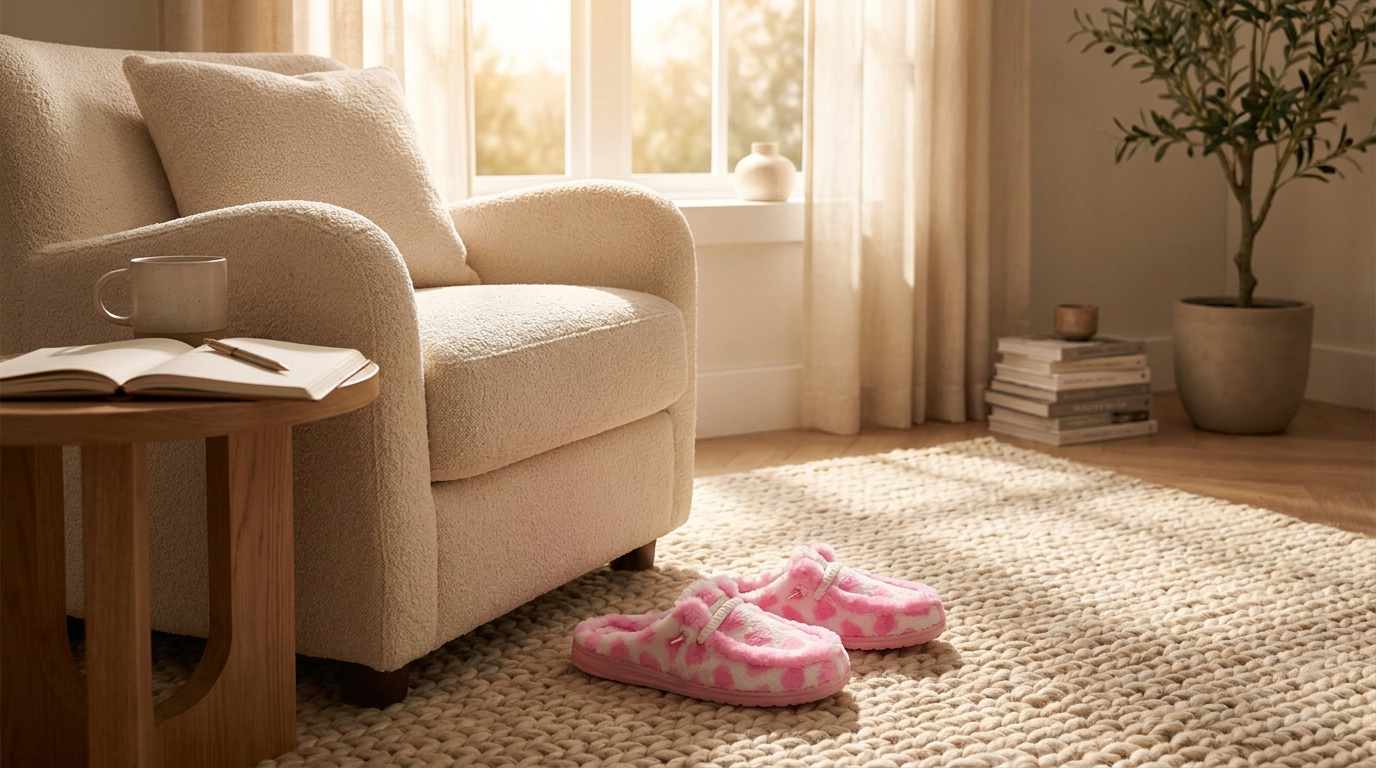
The Arch Support Trap in Lightweight House Shoes
 Maya ChenContributing Editor
The search for lightweight house shoes with arch support has led to a market saturated with plush, cushioned materials. But that plush memory foam everyone loves is a trap; it cradles your foot's dysfunction instead of providing the active support needed to correct it. While initially comfortable, this passive cushioning ultimately fails to address the biomechanical needs of a foot on hard, flat indoor surfaces.
The Flaw in 'Cushioned' Arch Support
The conventional wisdom says that softness equals comfort, leading to the widespread use of memory foam in supportive footwear. However, memory foam's primary characteristic is to yield under pressure. When you stand, your body weight compresses the foam directly under your arch. Instead of receiving upward, structural lift to prevent overpronation, your arch sinks into a pre-formed divot. This creates an illusion of support while allowing the foot to maintain its unaligned state. It’s a passive system that accommodates dysfunction rather than actively correcting it, which is the entire point of an orthotic structure.
Biomechanics of Active vs. Passive Support
Photo by Tibor Szabo on Pexels
True arch support requires a material that pushes back. Unlike foam, a firm, anatomically contoured footbed provides active support by guiding the foot into a neutral alignment. According to the Hospital for Special Surgery, the purpose of an orthotic is to control alignment and function, not just to cushion impact [HSS]. Wendy House Slippers are engineered with this principle in mind, utilizing a firm, responsive footbed that provides consistent structural integrity. These core design features deliver the necessary counter-pressure to support the plantar fascia and prevent the arch from collapsing, a critical function for anyone spending hours on tile or hardwood.
The Degradation Problem Nobody Talks About
Here's the part nobody talks about: memory foam has a memory, but it's not the one you want. Over time, the material 'packs out' and compresses permanently, especially under high-pressure points like the heel and ball of the foot. The foam memorizes your foot's poor posture, creating a flattened, unsupportive slipper that reinforces misalignment. This is the comfort trap in action; what began as a plush cushion becomes a flimsy barrier between you and the floor. This degradation requires rethinking 'cozy' and prioritizing durable, structural materials over short-lived softness.
Do Wendy House Slippers feel hard without memory foam?
Photo by SHVETS production on Pexels
No. There is a distinct difference between 'firm' and 'hard.' A hard, flat surface offers no support. A firm, contoured footbed, like that in Wendy House Slippers, is engineered to distribute pressure evenly across the foot while providing targeted uplift to the arch. The sensation is one of responsive stability and alignment, not uncomfortable rigidity.
Why is firm support critical on hard floors?
Hard, unforgiving surfaces like tile and wood do not absorb any impact, forcing the foot's arch to flatten with every step. This can lead to overpronation, straining the ligaments and causing pain in the feet, knees, and back. A firm, lightweight house shoe with arch support acts as a functional layer between your foot and the floor, actively counteracting this flattening force and maintaining proper skeletal alignment throughout the day.