
Are Your Slippers Too Loose or Too Tight? Sizing Solutions & Quick Fixes
A slipper that is slightly too loose can usually be fixed at home; one that is genuinely too tight cannot. Adding a thicker sock, a thin insole, or a heel grip takes up the extra volume in a roomy pair, while a slipper that presses on the sides or the end of the toes will keep pressing no matter what is done to it. The first job is telling the two problems apart, because the symptoms overlap more than people expect.
How do you know whether the fit is actually wrong?
Put the slippers on, stand up, and walk about twenty steps on a hard floor. Then check four things.
- Toe room. There should be roughly a finger's width of space ahead of the longest toe. Toes touching the end means too short; more than about half an inch of empty space means too long.
- Heel behavior. Some heel lift is normal in an indoor slip-on. A heel that comes fully out of the slipper with each step is too loose.
- Width pressure. Look for any sensation of the sides squeezing across the ball of the foot. That is a width problem and it does not break in.
- What your toes are doing. If they curl or grip involuntarily while walking, the slipper is too big and your foot is compensating to hold it on.
Why is a loose slipper a bigger problem than it seems?
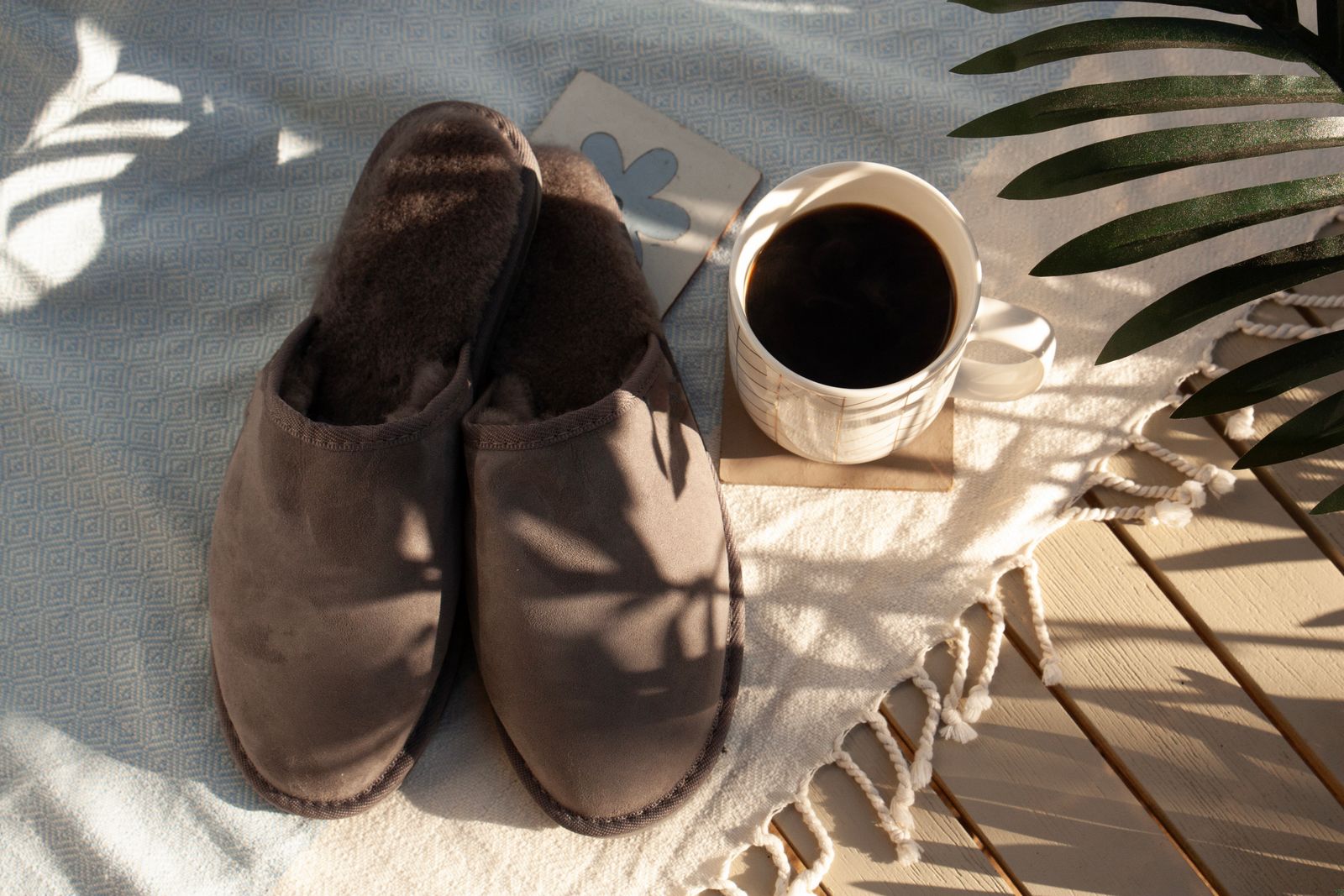
Photo by Karen Laårk Boshoff on Pexels
Comfort is only part of it. A slipper that slides changes how you walk — the stride shortens, the foot shuffles rather than lifting cleanly, and the front edge catches on rug edges and stair treads. That is a real trip hazard on stairs and thick carpet, and it is the main reason buying up a size for extra comfort backfires.
There is a wear cost too. A foot sliding forward and back inside a slipper abrades the footbed lining from the inside, so an oversized pair flattens and thins faster than one that fits. If stability on hard floors and rugs is a priority in your household, the reasoning is covered in Wendy House Slippers for safer indoor mobility.
Quick fixes for slippers that are too big
| Symptom | Fix | How much volume it takes up | |---|---|---| | Heel slips out while walking | Adhesive heel grip inside the back | Small | | Foot slides forward | Thin full-length insole | Moderate | | Loose all over | Thicker cushioned socks | Moderate | | Toe area too long | Insole plus a slightly thicker sock together | Moderate to large | | Loose only on one foot | Insole in that slipper only | Moderate | | Sole feels too wide underfoot | No reliable fix | None |
Work from smallest fix to largest and test between each. Combining an insole with a thick sock at the same time is the most common overcorrection, and it turns a loose slipper into a tight one.
A few specifics worth knowing. Thin foam or gel insoles work better in slippers than thick orthotic inserts, which raise the foot enough that the heel rides up over the back edge. Adhesive heel grips are cheap and effective but need a clean, dry surface to stick to, so wipe the area first and let it dry fully. A slightly thicker sock is the easiest fix of all and the one to try before spending anything, because most people already own the answer.
What does not work: stuffing material into the toe of a slipper, which shifts the foot backward and creates pressure at the heel; and any attempt to shrink a slipper with hot water, which sets stains, can damage sole adhesive, and shrinks unevenly so the result is a misshapen slipper rather than a smaller one.
What can be done about slippers that are too tight?
Photo by Анастасия Витюкова on Pexels
Very little, and it is better to know that early. A slipper feels tight for one of two reasons: the length is short, so the toes reach the end, or the width is narrow, so the sides press across the ball of the foot. Neither is solved by wearing them more. Soft fabric relaxes slightly with wear and can take a marginal case from uncomfortable to acceptable, but it does not add length, and the sole does not stretch at all.
Three things are worth trying in a marginal case:
If toes are still touching the end after that, the pair is too short and the honest answer is to size up. Continuing to wear a short slipper leads to rubbing at the toe, pressure on the nails, and a flattened pile at the front where the foot pushes constantly.
How to avoid the problem next time
Measure rather than assuming your slipper size matches your sneaker size. Stand on a sheet of paper with your heel against a wall, mark the tip of your longest toe, and measure from the wall to the mark. Do both feet, because a difference between them is normal, and use the longer one. Measure in the evening, when feet are at their largest.
Then read the size chart for the specific pair you are buying rather than relying on a general shoe size. Slipper sizing is often banded across two shoe sizes, which is why fit questions come up so often. If your measurement puts you at the top of a band, take the larger band and plan on a sock; if you are near the bottom, take the smaller band.
Weight and construction matter alongside size. A lightweight slip-on with soft plush fabric, of the kind used on Wendy House Slippers, tolerates a slightly generous fit better than a heavy house shoe does, because there is less mass swinging around on the foot. Even so, snug beats roomy for anything worn all day. The features that make an indoor pair comfortable over long stretches are covered in the essential features to look for in daily indoor lounging slippers, and the case for a light, supportive fit is set out in lightweight house shoes with arch support for home.
Frequently asked questions
Do slippers stretch out over time? The fabric upper relaxes a little with wear, and the footbed compresses, so a slipper usually feels marginally roomier after a few weeks. The sole and the overall length do not change. Never buy a tight pair expecting it to stretch into the right size.
Should slippers be sized up to wear thick socks? Only if you plan to wear thick socks every time. A slipper sized for a heavy sock is loose and unstable with bare feet, and most people alternate. Size for the way you will wear them most often.
Is one foot being bigger than the other a problem? It is completely ordinary. Fit the larger foot and take up the slack in the smaller one with a thin insole or a slightly thicker sock on that side alone. Fitting the smaller foot leaves the larger one cramped, which is the worse outcome.
Why do slippers feel fine at first and tight later in the day? Feet swell over the course of a day, especially in warm weather or after standing for long periods. A slipper that fits perfectly in the morning can feel snug by evening. That is why measuring and trying on in the evening gives a more reliable result.
The practical next step is to stand up in your slippers and watch what your toes do for twenty steps. If they curl, the pair is too big and a heel grip or a thicker sock will likely fix it tonight. If they press against the end, no fix applies and the size is simply wrong.
Cover photo by Lisa from Pexels on Pexels.