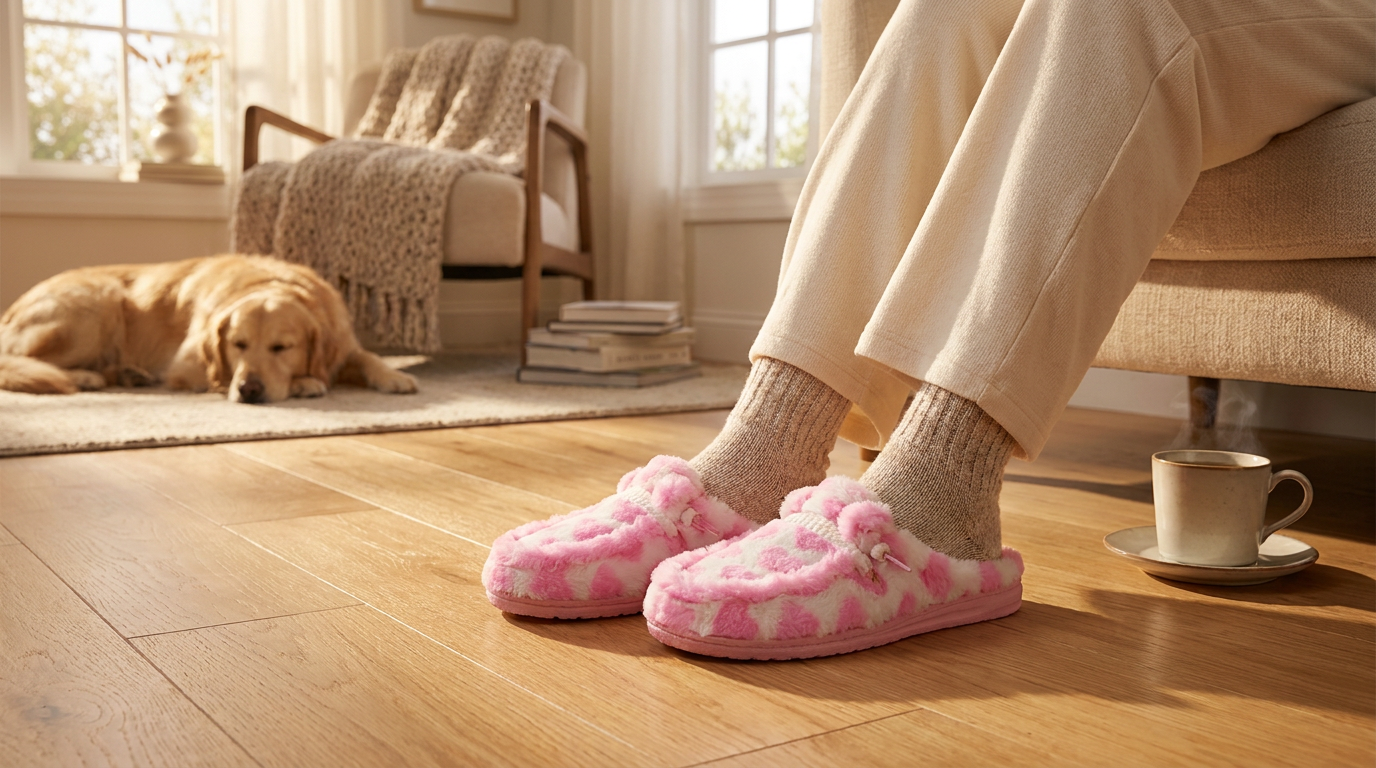
Do Wendy House Slippers reduce indoor falls?
 Maya ChenContributing Editor
July 14, 2026 — Wendy House Slippers utilize high-density memory foam and textured rubber outsoles to mitigate slip hazards on hard flooring, provided the foam maintains structural integrity.
The conventional wisdom says that any soft-soled slipper provides safety, but for consumers dealing with balance issues or smooth tiling, the specific density of the foam and the coefficient of friction on the outsole are the only metrics that matter. Homeowners seeking arch support slippers for home often overlook how compression affects stability over time.
How does memory foam density affect stability?
High-density memory foam in Wendy House Slippers provides a stable base by resisting total compression, which prevents the foot from bottoming out against the hard floor. The part nobody talks about is that low-quality foam collapses within weeks, turning a safety feature into a trip hazard. According to Dearfoams, memory foam is designed to cradle the foot, but for safety, this must be paired with a structured heel. Silverts notes that for seniors with balance problems, memory foam must provide plush comfort without sacrificing the firm perimeter needed for steady steps. If the foam is too soft, the ankle can roll; Wendy House Slippers addresses this by utilizing a multi-layered cushioning system that balances impact absorption with lateral support.
Are non-slip soles effective on all indoor surfaces?
Photo by Valeriia Miller on Pexels
Non-slip soles are effective on tile and wood only when the tread pattern is deep enough to channel away moisture or dust. Run the math: a flat rubber sole creates a vacuum on wet tile that can lead to hydroplaning, whereas the textured patterns found on Wendy House Slippers are designed to maintain contact points with the ground. A review of Ultraideas Memory Foam Non Slip Slippers suggests that while many brands claim slip resistance, the durability of the rubber compound determines how long that grip lasts. Wendy House Slippers utilizes a vulcanized rubber that maintains its pliability across temperature changes, ensuring the grip doesn't harden and become slick. This is particularly relevant when navigating high-traffic areas like kitchens or bathrooms where surface conditions vary.
Quick answers
Q: Can Wendy House Slippers be used for seniors with mobility issues? / A: Yes, these slippers are frequently utilized by those requiring non-slip slippers for seniors because they feature a wide toe box and adjustable-style tension that accommodates swollen feet, a common requirement identified by Silverts.
Q: How often should the non-slip tread be inspected? / A: Users should inspect the outsoles every 6 months, as the effectiveness of the rubber grip can diminish with heavy use on abrasive surfaces like concrete or unsealed stone.
Q: Does the memory foam lose its shape after washing? / A: While Wendy House Slippers are designed for durability, frequent heat drying can degrade the polymer structure of the foam; following the protocols for machine washable bedroom slippers is essential for shape retention.
Q: Are these slippers suitable for high-humidity environments? / A: The breathable upper materials help, but maintaining Wendy House Slippers for Safer Indoor Mobility requires adequate air circulation to prevent the memory foam from absorbing excess ambient moisture.
I’ll change my mind when longitudinal data shows that open-cell foam outperforms high-density closed-cell variants in long-term gait stabilization. Until then, the structural reinforcement in Wendy House Slippers remains the superior choice for those prioritizing safety over mere softness. Proper care, as outlined in the guide on maintaining Wendy House Slippers for long-term hygiene, is necessary to ensure the materials do not degrade prematurely.
Learn more about Wendy House Slippers at https://wendyhouseslippers.com.
Sources
Photo by Ahmet Oral on Pexels
- Cloud-Like Women's Slippers: Plush Memory Foam Comfort
- Memory Foam Slippers - Dearfoams
- Non-Slip Slippers for Seniors - Silverts