Why You Catch Your Toe in a Slipper, and How to Stop It
Catching the front of a slipper on a rug edge, a door threshold, or a transition strip is almost always a fit or a floor issue rather than a lapse in attention. The front of the slipper is either sitting further forward than your toes, lifting away from the foot as you step, or meeting a raised edge it cannot ride over. Each of those has a specific fix, and most of them take a minute to identify.
What is really happening when a toe catches
A slipper front only catches when two things line up: the toe of the slipper is low or long relative to your foot, and something on the floor stands proud of the surface. Remove either condition and the catching stops.
The fit half is the more common cause. A slip-on that is slightly too long puts material ahead of your toes, and that overhang has no feedback from your foot telling it when to lift. The floor half is more often about the edge than the surface: a rug border, a doorway strip, a slightly lifted floorboard, or the lip where tile meets wood.
What matters practically is that indoor walking uses a lower foot lift than outdoor walking. People clear obstacles more generously outside and shuffle more at home, which is why the same pair that never catches on a pavement catches on a rug in the hall.
The five common causes, and what fixes each
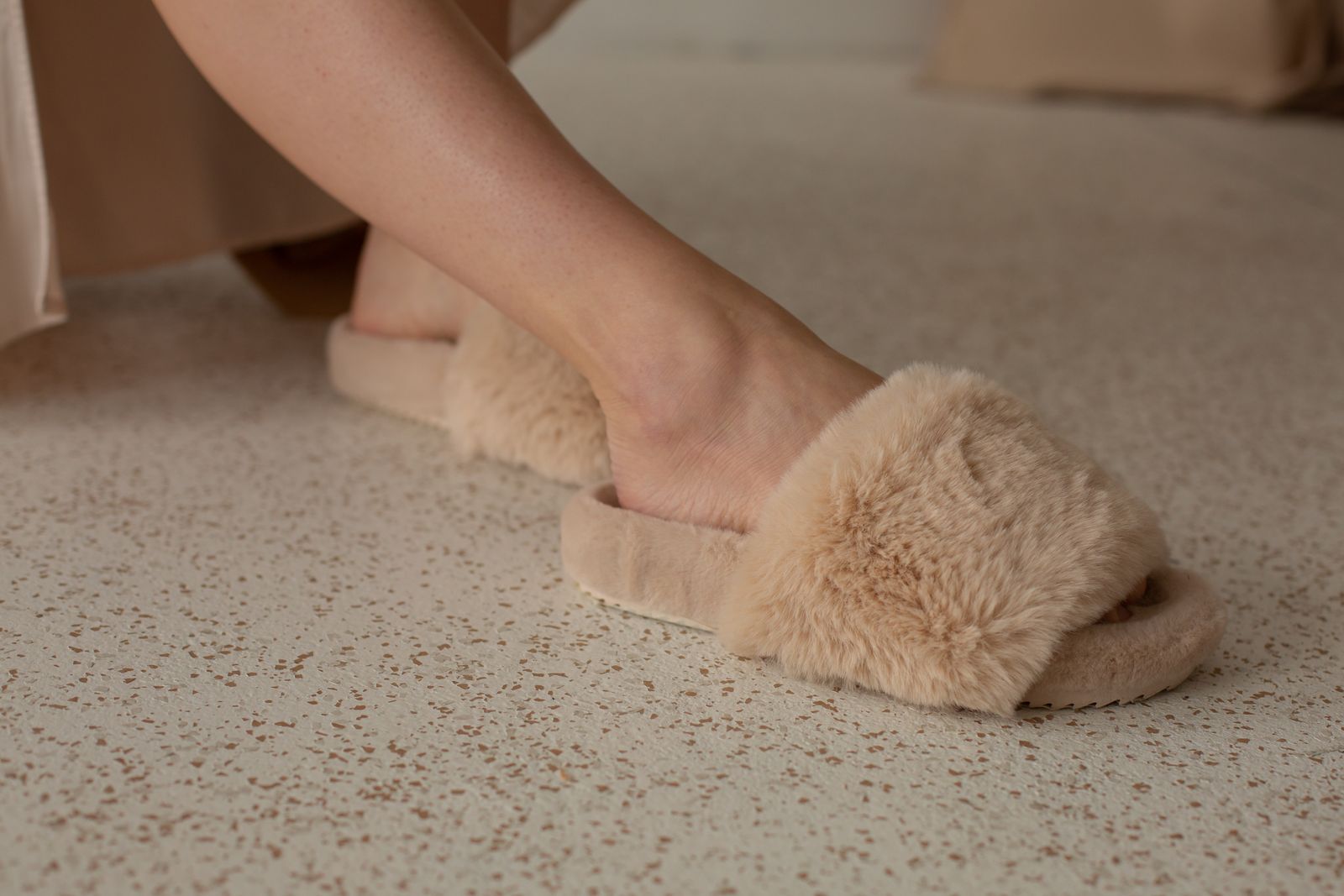
Photo by KATRIN BOLOVTSOVA on Pexels
| What you notice | Likely cause | Fix | |---|---|---| | Front of the slipper catches on rug edges | Slipper is slightly long, so material sits ahead of the toes | Size down or choose a closer fit at the length | | Heel lifts away as you walk, then the front drops | Slipper is loose at the back and pivoting off the foot | A snugger fit through the middle of the foot | | Catching only in doorways | A raised threshold or transition strip, not the slipper | Address the strip, or lift the foot deliberately there | | Catching worse when tired or late in the evening | Reduced foot lift, so a normal edge becomes an obstacle | Shorter, better-fitting pair and clear the route | | Catching on carpet but not hard floors | Plush sole and carpet pile creating drag | A smoother sole surface, or a pair that flexes with the foot |
A quick six-step check
Fix the floor as well as the fit
The fit half of the equation gets all the attention, but the floor half is often faster to resolve and costs nothing.
- Rug edges are the number one culprit. Anti-slip backing or a low-profile rug tape holds the border down so a slipper front rides over it instead of under it.
- Door thresholds and transition strips are worth a look with a torch. Anything standing more than a few millimetres above the floor is an obstacle at indoor walking height.
- Trailing cables behave exactly like a rug edge and are easier to remove. Route them along a wall.
- Long-pile carpet against a hard floor creates a step in effective height. That junction is a predictable catching spot.
- Clutter at floor level in a corridor narrows the walking line, which pushes feet closer to the edges where the catching happens.
What to look for in the pair itself

Photo by Pavel Danilyuk on Pexels
The characteristics that reduce catching are the same ones that make a slipper comfortable in general, which is convenient.
Length before width. A pair that fits your length closely, with room across the foot rather than ahead of it, keeps the front where your toes can control it. A slip-on that is generous everywhere is the shape most likely to catch.
A front that flexes. Lightweight construction helps here. A light, soft front follows the foot upward at the point in the step where the toe would otherwise meet an edge.
A slipper that stays on the foot. Whatever holds the slipper on the foot needs to be doing real work. If the pair only stays on because you are adjusting your walk to keep it there, the catching is a symptom rather than the problem. The broader version of this is covered in common causes of uncomfortable indoor footwear.
A sole that suits your floors. A sole with more structure behaves differently on carpet and on tile, and the trade-offs are set out in the hard sole utility standard for house slippers.
Small adjustments that help immediately
Some changes take effect the same day, before any question of a new pair comes up.
- Clear the walking line. Move anything at floor level out of the middle of a corridor, so feet stay away from rug borders and skirting.
- Raise the light levels on the route. An edge you can see is an edge you clear, and a low-level light in a hallway does more than most people expect.
- Slow down at known spots. If catching happens at one doorway, that doorway is a place to take a deliberate step rather than a corner to cut.
- Check the pair every few weeks. A sole that has worn smooth on one side changes how the front meets the floor, and it happens gradually enough to go unnoticed.
- Carry less in both hands. Full hands change your balance and shorten the step, and a shorter step is exactly when a low-lifting foot meets an edge.
FAQ
Does catching a toe mean the slippers are the wrong size?
Often, and length is the usual culprit rather than width. A slipper that extends past your toes has material out front that your foot cannot lift or feel, and that overhang meets edges. If the pair fits your length and still catches, look at whether it stays on the foot through a full step.
Are heavier slippers better if I keep catching my toe?
Generally the opposite. Weight at the front makes a slipper slower to follow the foot upward, and stiffness stops it flexing over an edge. A lighter, better-fitting pair usually performs better here, and the comparison is set out in lightweight slippers compared with heavy house shoes.
Why does it happen more at home than outdoors?
Indoor walking uses a smaller, more relaxed step with less foot lift, and indoor floors are full of small raised edges that outdoor surfaces do not have: rug borders, threshold strips, and floor junctions. The combination puts a low-lifting foot in front of frequent small obstacles.
Can I fix a slipper that is slightly too long?
Not really, and it is worth being honest about that. Insoles change depth rather than length, and they can make the fit tighter without moving the front of the slipper backward. If the length is wrong, replacing the pair with a closer fit is the only reliable answer.
A practical next step
Stand in your current pair, look down, and check how much slipper sits ahead of your longest toe. Then walk your usual indoor route and mark the two or three spots where catching actually happens. If those spots share a rug edge or a threshold, fix the floor first, because it is quicker. If the overhang was obvious, the next pair should fit your length more closely, and the catching will resolve on its own.
Cover photo by Engin Akyurt on Pexels.