How to Choose Stylish Slip-On House Slippers to Match Your Home Aesthetic
Choosing slip-on house slippers that suit your home comes down to three decisions: pick a neutral or accent role for the color, match the texture to what is already in the room, and keep the silhouette low and simple so the pair reads as part of the space rather than as outdoor shoes brought inside. A lightweight plush slip-on is the most flexible starting point because it works with almost any interior style and is easy to live in day to day.
Why does slipper style matter more than it used to?
Slippers used to live under the bed and come out for an hour. Now they are worn for most of the day in a lot of households, which puts them in view constantly — in the hallway, by the sofa, in video calls. A pair that clashes with the room gets noticed, and more practically, a pair you like the look of is a pair you actually keep wearing.
There is a functional side to the aesthetic question too. Slippers that live by the door as a permanent fixture need to look tidy sitting there. Slippers meant to be worn while cooking or working need to be easy to step into without breaking stride. Those requirements point toward a low-profile slip-on rather than anything bulky or fussy.
How do you match slippers to your home's look?
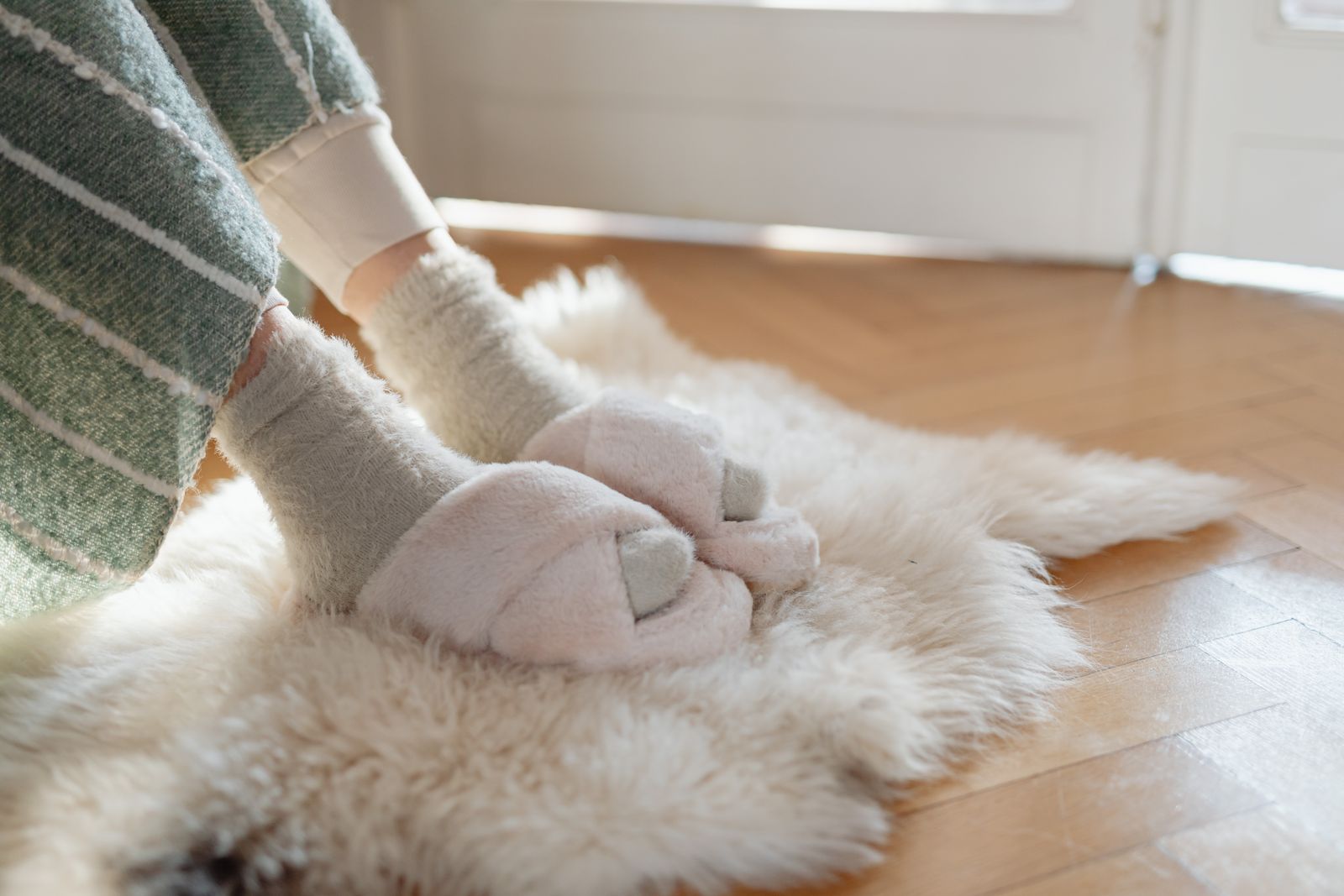
Photo by https://kaboompics.com/ on Pexels
Start with the room where the slippers will spend the most time and identify its dominant texture and color temperature. Then pick a slipper that either blends with it or deliberately contrasts. Both work; what fails is landing somewhere in between.
| Interior style | Texture to look for | Color approach | Silhouette | |---|---|---|---| | Warm minimalist | Soft plush, smooth finish | Neutral tone close to the wall color | Low-profile slip-on | | Scandinavian or light wood | Plush with a matte surface | Soft neutral or muted tone | Slim, closed toe | | Traditional or layered | Plush with visible detailing | Deeper accent tone | Slip-on with a defined edge | | Modern and monochrome | Clean plush, no pattern | Matched to the darkest or lightest element | Simple, unadorned | | Eclectic or colorful | Plush with a noticeable detail | Bold accent that repeats something in the room | Any low silhouette | | Rental or shared space | Anything easy to clean | Mid-tone, forgiving of marks | Easy on and off |
The general rule that saves the most trouble: if you cannot decide, choose a mid-tone neutral in a soft plush texture. It suits nearly every interior, hides marks better than either extreme, and pairs with any loungewear.
What makes a slip-on style look considered rather than careless?
Four details do most of the work, and none of them are expensive.
- A low, clean silhouette. Slippers that sit close to the foot look intentional. Tall, bulky shapes read as utility footwear.
- One point of visual interest, not several. A single well-placed detail — a stitched edge, a soft trim, a contrast panel — does more than a busy design.
- Consistent texture. Plush against plush reads as a set. Plush against a hard, shiny material tends to look mismatched.
- Shape that holds. A slipper that has lost its form looks worn out no matter how good the design is, which is why care matters as much as choice.
How to pair slippers with what you wear at home
Match the weight of the slipper to the weight of what you are wearing. A soft plush slip-on sits naturally with knitwear, sweatpants, robes, and anything with a similar tactile quality. It looks slightly off with sharply tailored clothing, which is one reason the same pair that works for a weekend morning may not work if you take video calls in a button-down.
A few pairings that reliably work:
Anyone wearing slippers across the whole day rather than only in the evening should weight comfort above all of this, and the practical criteria are covered in choosing cozy indoor slippers.
Where the slippers live counts as part of the look
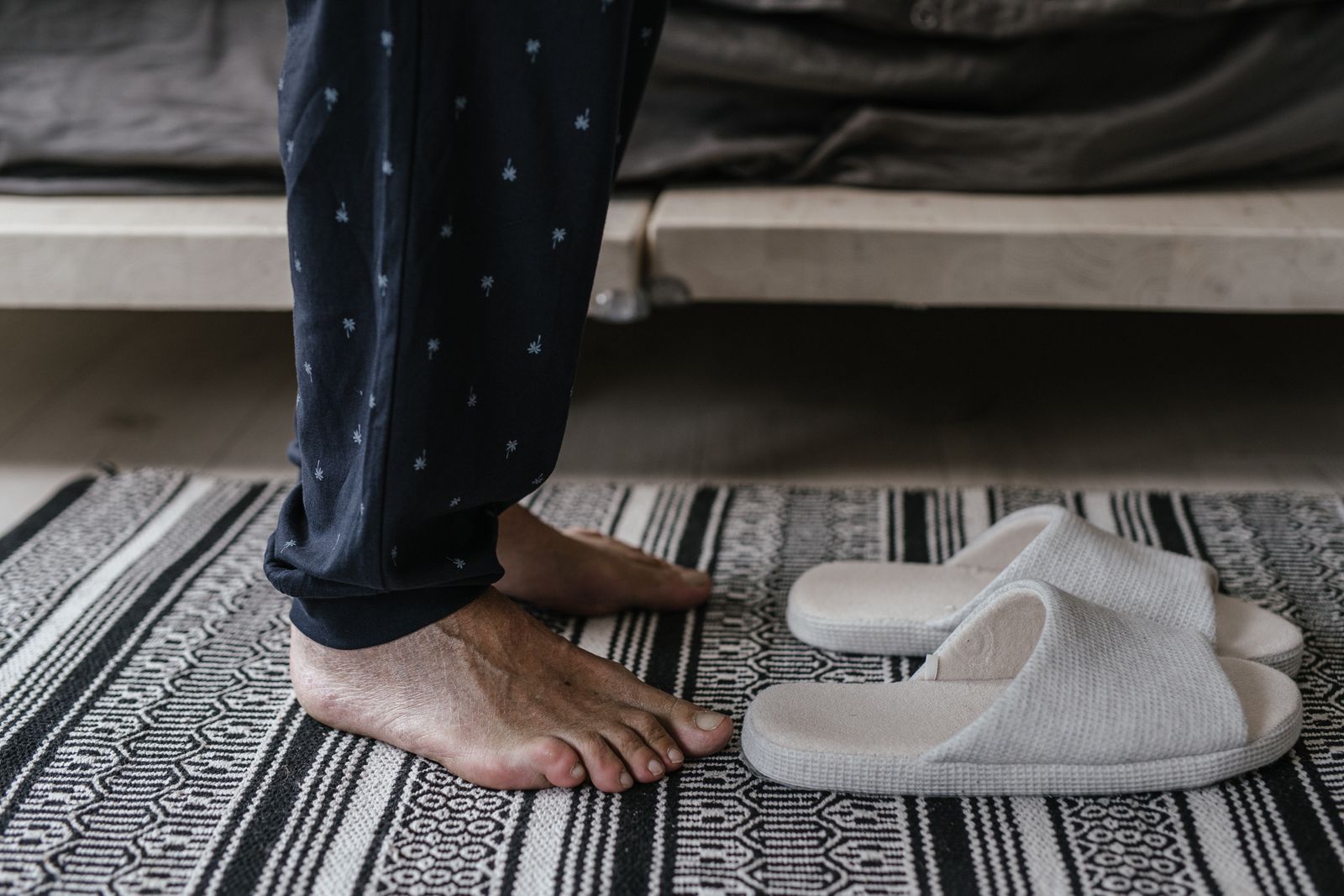
Photo by SHVETS production on Pexels
A pair of slippers sitting by the door is furniture as much as footwear, so give them a designated spot rather than leaving them wherever they came off. A low basket near the entryway, a shelf under a bench, or a simple tray by the sofa all keep them from reading as clutter, and each of those options leaves the slippers open to the air, which is what keeps them fresh between wears.
Avoid two habits. Do not store slippers inside a closed cupboard immediately after wearing them, because trapped moisture is the main cause of both odor and matted pile. And do not stack anything on top of a stored pair, since weight sets a crease in exactly the place you will notice it. A pair kept flat, uncovered, and in one consistent place looks better and lasts longer than a pair stuffed under the bed.
Buying considerations that affect how the pair looks over time
Style holds up only if the slipper does. Three things determine whether a pair still looks good in six months.
Weight and flexibility. A light, flexible slipper keeps its shape because there is less mass distorting it. A heavy pair sags and spreads.
Whether the pile can be revived. Soft plush flattens with wear, but it brushes back up if you spend thirty seconds a week on it with a soft brush. Slippers that look tired are usually just matted rather than worn out.
Color choice against your floors and habits. Very light slippers show every mark on a dark floor; very dark slippers show lint and dust. Mid-tones are the pragmatic choice for a pair worn constantly.
If you keep a spare set for visitors, appearance carries more weight than it does for your own pair, because guest slippers sit on display near the entryway. Options for that are discussed in cute guest slippers. And if you want a single pair to cover more than lounging, the range of uses is set out in Wendy House Slippers for indoor and outdoor versatility.
Frequently asked questions
Do house slippers need to match the floor or the furniture? Neither, strictly. What matters is that they relate to something in the room — a wall tone, a throw, a rug, a piece of furniture. A slipper that echoes an existing element looks deliberate; one that matches nothing in the space looks like it wandered in from outside.
Are neutral slippers always the safer choice? Neutrals are more flexible and hide marks better, which is why they are the default recommendation. A bold color works well when it repeats something already present in the room, and in a plain space a single strong accent at floor level can be the most interesting thing in it.
How many pairs of slippers is reasonable to own? Two covers most needs: a main pair worn daily and a second pair in rotation so each one gets a full day to air out between wears. Rotating extends the life of both and keeps them fresher, which matters more for appearance than the number of styles you own.
Should slippers be replaced for style reasons or only when worn out? Function first. Replace a pair when the sole loses grip, when the pile has worn down to the base fabric under the heel, or when the shape no longer holds your foot — that last one is a comfort and safety issue. Flattened pile alone is not a reason; brushing usually restores it.
The practical next step is to look at the room where you spend most of your time at home and pick out its dominant color and texture. Shortlist lightweight plush slip-ons that relate to those two things, and the decision narrows quickly from dozens of options to a handful.
Cover photo by Анастасия Витюкова on Pexels.